Employer-sponsored green card
A green card through your employer: which category is yours?
Employers can sponsor workers for permanent residence in three categories. The right one depends on the job, your education and your achievements. Here is the full picture in one place.
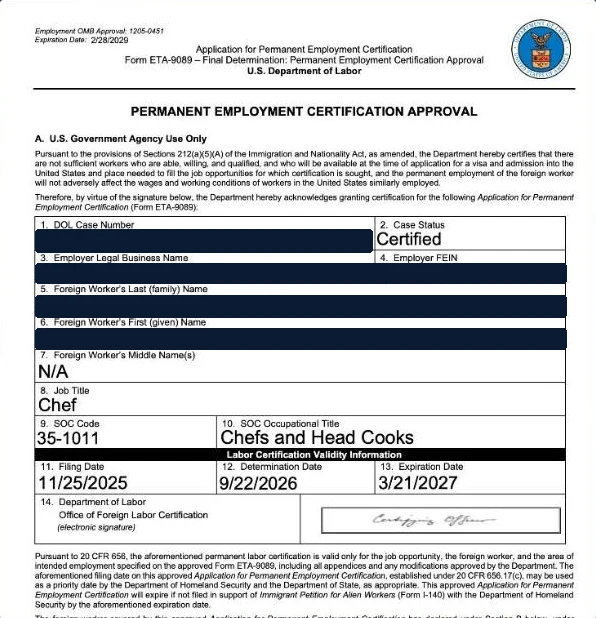
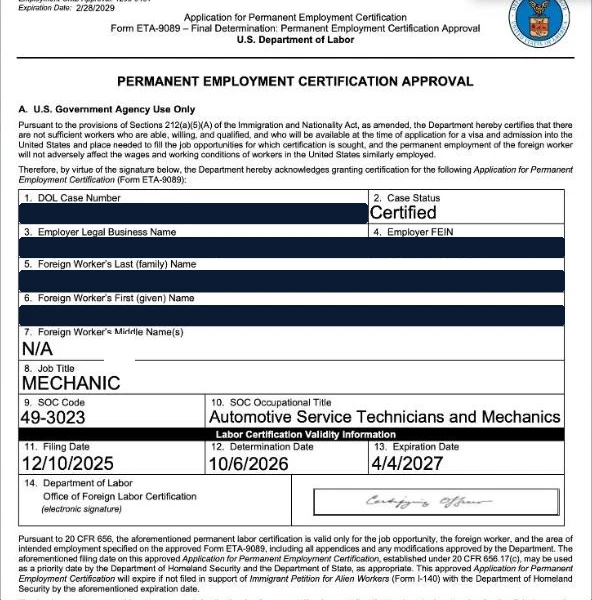
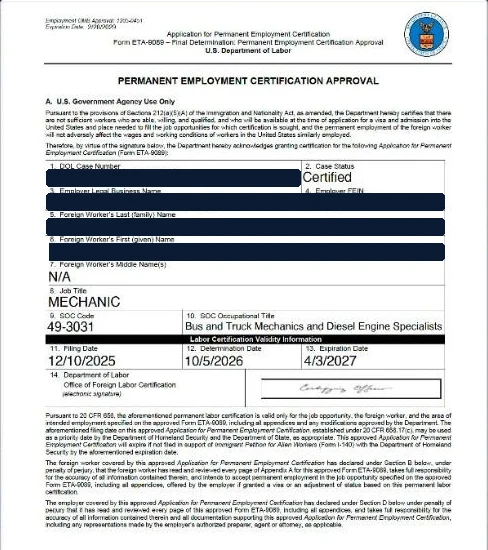 CERTIFIEDOur EB-3 approvals in 2026Truck mechanics, chefs, a cashier, a nanny. Real documents.See our cases

What is an employer-sponsored green card?
It is permanent residence based on a job with a U.S. employer. The employer files the petition (Form I-140), usually after a PERM labor certification. Then you file for the green card in the U.S. or at a consulate.
There are three preference categories: EB-1 for top talent and managers, EB-2 for advanced degrees and exceptional ability, EB-3 for professionals, skilled and other workers. Most employer-sponsored cases are EB-2 or EB-3.
Compare
EB-1, EB-2, EB-3 at a glance
| EB-1 | EB-2 | EB-3 | |
|---|---|---|---|
| Who | Extraordinary ability, top researchers, multinational managers | Advanced degree or exceptional ability | Bachelor's, 2 years experience, or other workers |
| PERM needed | No | Yes (except NIW) | Yes |
| Employer needed | Not for EB-1A | Not for NIW | Yes |
| Typical total time | Shortest | Medium | 2-4+ years |
Visa Bulletin waits depend on the month and your country of birth.
Find yourself
Which category fits you?
Most likely EB-3
- Skilled workers need 2 years of experience or training
- Other workers need less than 2 years
- Employer files PERM and I-140
EB-3 professionals, sometimes EB-2
- Bachelor's + 5 years of progressive experience can mean EB-2
- Otherwise EB-3 professionals
- Compare the Visa Bulletin for both
EB-2, maybe NIW
- EB-2 with PERM through your employer
- Or EB-2 NIW without an employer if your work has national importance
EB-1 or O-1 first
- EB-1A without an employer
- EB-1B for outstanding researchers
- EB-1C for multinational managers

Who pays
The employer pays for PERM. Always.
U.S. rules say the employer pays PERM costs, including recruitment and attorney fees for PERM. Other fees can be shared.
- Employer: PERM, recruitment, PERM attorney
- Usually employer: I-140 fees and Asylum Program Fee
- Either: premium processing
- Usually worker: I-485 for the family, medical exam
Guides
Everything about sponsored green cards

Skylex Immigration Lawyer
Skylex handles your case from start to finish
Sponsored Green Card is a guide by Skylex Immigration Lawyer PLLC. Our team prepares PERM, I-140 and the green card step for employers and workers across the U.S.
Not sure which category you fit?
A lawyer compares EB-1, EB-2 and EB-3 for your profile.
News
Latest news
PERM is getting faster: about 10-11 months instead of 16
The Department of Labor has cut PERM review times sharply during 2026. What it means for a case filed today.
ReadConsulates are still delaying green card interviews. What EB-3 workers abroad should do
Since late August, U.S. embassies have been rescheduling immigrant visa interviews. The delays continue in November.
ReadNew PERM rules are coming: the first overhaul since 2004
A Department of Labor proposal to change PERM recruitment has cleared White House review. Here is what we know.
ReadFAQ
Questions about sponsored green cards
What is an employer-sponsored green card?
Permanent residence based on a job offer from a U.S. employer, in EB-1, EB-2 or EB-3.
Does every category need PERM?
No. EB-1 and EB-2 NIW do not. EB-2 (regular) and EB-3 do.
Which category is fastest?
Usually EB-1, but it depends on the Visa Bulletin for your country.
Who pays?
The employer pays PERM by law. Other fees can be shared.
How long does it take?
From about a year for some EB-1 cases to 2-4+ years for EB-3.
Can I speed it up?
Only I-140 has premium processing ($2,965).

Free immigration consultation
Not sure if EB-3 fits you? Book a free consultation with Skylex Immigration Lawyer in the Skylex app.